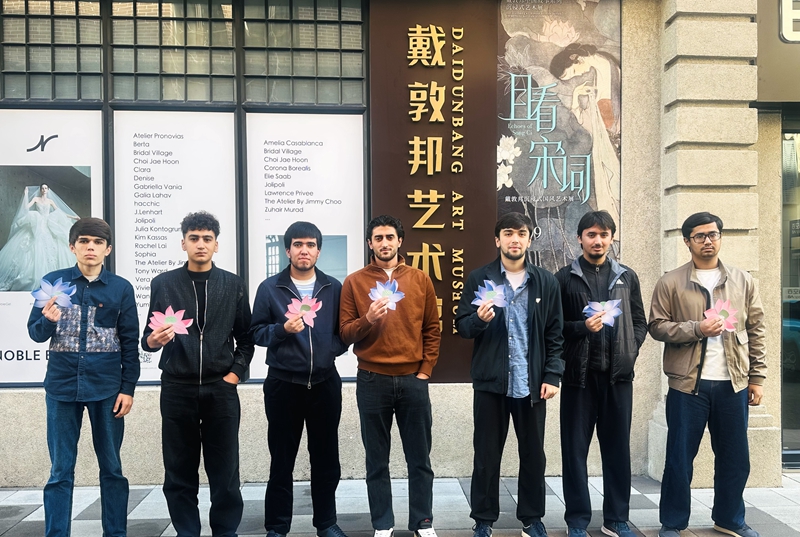
On the afternoon of November 11, the International Cooperation Division of the College organized a visit to the Dai Dunbang Art Museum for the 2026 cohort of Tajik international students, where they viewed “Behold the Song Ci — Dai Dunbang Immersive Chinese-Style Art Exhibition.” The event was one of the traditional Chinese culture experience activities that the International Cooperation Division offers to international students.
Centered on more than 50 of Mr. Dai Dunbang’s figure paintings inspired by Song ci poetry, the exhibition links together more than 40 ci poets of the Northern and Southern Song dynasties and over 80 poems handed down through the centuries, and combines a wide range of display techniques, including life-size scene reconstruction, light-and-shadow installations and three-panel screen projections. For international students encountering Song ci systematically for the first time, the paintings and the interplay of light bridged the language barrier, enabling them to experience in an immersive way the beauty of Song ci imagery and the profound richness of traditional Chinese culture.
As they toured the exhibition, the international students were completely absorbed — at times pausing to gaze at the flowing sleeves and expressions of the figures in the paintings, at other times discussing in low voices the stories behind the lines of verse. The students said that, although their Chinese was still improving, the presentation through painting, light and staged scenes had allowed them to genuinely “see” the world depicted in Song ci and to feel the poetry and romance that have endured for a thousand years. After the visit, the international students went on to the Bund together. Along the Huangpu River, the ensemble of buildings from around the world faced the Oriental Pearl Tower across the water, and as they strolled, the students gained a direct sense of Shanghai’s historical heritage and modern vitality.
Experiencing traditional Chinese culture is an important part of the work of educating international students. The International Cooperation Division will continue to draw on high-quality social resources such as museum–university cooperation to organize varied hands-on activities, so that international students can come closer to China’s fine traditional culture, improve their Chinese proficiency and cross-cultural communication skills through personal experience, deepen their understanding of and identification with China and Chinese civilization, tell China’s story well, and contribute to people-to-people and cultural exchanges between China and the rest of the world.


Fengxian Campus: No.2080, Nanting Road, Fengxian district|Yangpu Campus: No.2360, Jungong Road, Yangpu District|Baoshan Campus: No.1168, Mohe Road, Baoshan District, Postal code:201999
Copyright © 2016 Shanghai Urban Construction Vocational College ALL rights reserved.