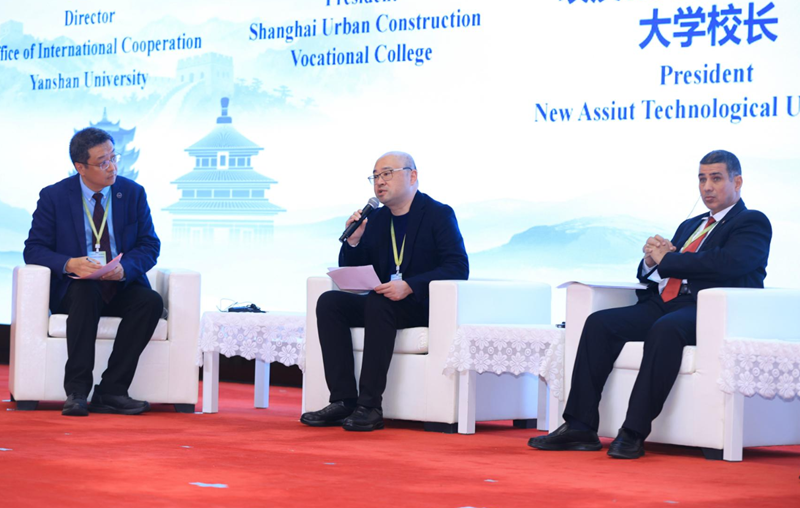
On the afternoon of November 11, the 2026 China–Africa Education Cooperation Innovation and Development Forum was held at the East Lake International Conference Center in Wuhan, Hubei Province. President Zhang Zhengrong was invited to attend and, in the “Face to Face with Ambassadors” dialogue session, appeared on the same stage with Chinese and international guests including Abdelkader El Ansari, Ambassador of the Kingdom of Morocco to China, and Gamal Tag Abdelgaber Abdelkader, President of New Assiut Technological University of Egypt, to discuss the internationalization of vocational education and China–Africa cooperation in talent cultivation, present the College’s educational practice and explore new paths for cooperation.
The forum was themed on promoting the innovative development of China–Africa education cooperation. Abdoulaye Salifou, Director of Education Cooperation at the UNESCO Liaison Office to the African Union; Gaspard Banyankimbona, Commissioner for Education, Science, Technology and Innovation of the African Union Commission; and Yu Changxue, Director-General of the China Center for International People-to-People Exchange under the Ministry of Education, delivered speeches in turn.
In his exchange remarks, Zhang Zhengrong said that the College has thoroughly studied and implemented General Secretary Xi Jinping’s important expositions on vocational education and on Chinese-foreign vocational education exchange and cooperation, and, holding firmly to the three main lines of educational exchange, skills exchange and people-to-people exchange, has built mechanisms for the co-construction and sharing of cooperation and continued to explore new models for cultivating internationalized talent. He noted that this year is the China–Africa Year of People-to-People Exchanges, and that China–Africa cooperation should become more oriented toward the people and take deeper root in people’s hearts. Africa is an important region for the joint construction of the Belt and Road Initiative and a priority direction for the College’s international cooperation. As a member institution of the Ministry of Education’s “China–Arab Universities 10+10 Cooperation Program”, the College has, since 2007, carried out educational cooperation successively with Egypt, Tanzania and other countries; in 2025, the College sent a delegation to Morocco and Tunisia, where it visited six institutions and related organizations and conducted on-site research into the development needs of vocational education in Africa. Relying on the platform of the “Future Africa — China–Africa Vocational Education Cooperation Program”, the College has pursued a differentiated approach in line with the concept of “asset-light entry, platform-based upgrading and brand-building consolidation”: in North Africa, it works with local universities on the joint training of construction professionals, incorporating cutting-edge technologies such as prefabricated construction, green and low-carbon buildings and BIM; for West African countries such as Guinea-Bissau, it draws on its strengths in food processing and food inspection and focuses on local specialty agricultural products such as cashew nuts, papayas and aquatic products, to fill the skills gaps in grading and processing, quality testing, cold-chain storage and transport, and quarantine for exports to China.
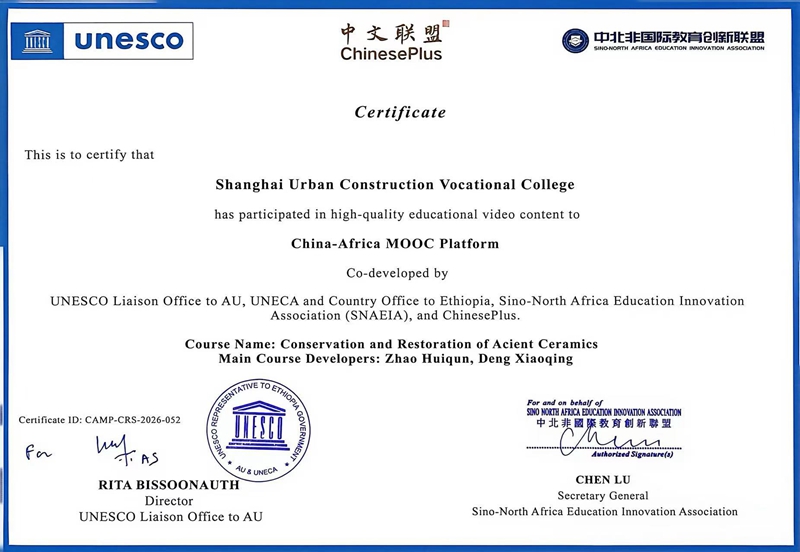
At the forum, the College was awarded the honorary title of “Outstanding Partner of the Supreme Council for Technical Education” by the Ministry of Higher Education and Scientific Research of Egypt. The video course resource “Protection and Restoration of Ancient Ceramics”, developed by the College’s Cultural Relics Restoration and Conservation program, has passed review by the UNESCO Liaison Office to the African Union and has officially gone online on the China–Africa MOOC Platform.
Next, the College will continue to align with the overall plan for the opening-up of national education, take serving China–Africa education cooperation as a key task of its internationalized operation, and keep deepening its work in areas such as the co-development of standards, talent cultivation and skills training, advancing the implementation of various cooperation projects with practical measures, and contributing new strength to deepening China–Africa education exchanges and supporting the joint construction of the Belt and Road Initiative.


Fengxian Campus: No.2080, Nanting Road, Fengxian district|Yangpu Campus: No.2360, Jungong Road, Yangpu District|Baoshan Campus: No.1168, Mohe Road, Baoshan District, Postal code:201999
Copyright © 2016 Shanghai Urban Construction Vocational College ALL rights reserved.